

[NEW EDITION]
NOW AVAILABLE
In the hope that it will foster a desire for research and reflection on pedagogical practice, the aim of this book is to illustrate, through the voices of educators, pedagogical coordinators, and principals, the pedagogical practice of Heuristic Play. It is thus a collection of pedagogical texts that, while sharing real-life experiences, offers guidance to readers seeking inspiration and insights into working with the Treasure Basket, Heuristic Play, and the Experimentation Table in educational institutions.
Paulo Sergio Fochi is a professor in the Education program and the coordinator of the specialization program in Early Childhood Education at Unisinos. He is also a faculty member in the“Innovative Teaching: Education for the 21st Century”program at Pós Educação Unisinos.
He is a researcher and collaborator with Contextos Integrados em Educação Infantil (USP/CNPq). He is a member of the Association of Early Childhood Education Professionals (Lisbon, Portugal), a member of Associação Criança (Braga, Portugal), and a member of the Special Interest Group – SIG Birth to Three (European Early Childhood Education Research Association – EECERA).
Fochi earned a bachelor’s degree in Education in 2007 and, over the next three years, completed specialized programs in early childhood education and school administration. In 2013, he completed his master’s degree in Education at the Federal University of Rio Grande do Sul (UFRGS), and in 2019, he earned his Ph.D. in Education from the University of São Paulo (USP), having previously completed a postdoctoral fellowship at the University of Barcelona in 2017.
Alongside his academic training, he founded the company Paulo Fochi Estudos Pedagógicos, which, since 2009, has been offering context-specific training for education professionals and educational institutions, as well as providing consulting services for cultural products and projects.
She founded the Observatory of Children's Culture (OBECI) in 2013, a community dedicated to supporting the professional development of early childhood education professionals. It currently brings together a group of six schools from four cities in Rio Grande do Sul.
Between 2015 and 2016, Paulo Fochi was one of four consultants and drafters of the first and second versions ofthe National Common Core Curriculum (BNCC) for Early Childhood Education (Brazil), a policy document prepared by the Ministry of Education (MEC) that outlines the essential learning outcomes for basic education.
Table of Contents
FOREWORD 7
INTRODUCTION TO THE PORTUGUESE EDITION 11
THE OBSERVATORY OF CHILD CULTURE: A COMMUNITY SUPPORTING PROFESSIONAL DEVELOPMENT 15
Schools Participating in OBECI 21
The Ideas That Guide Our Work 22
The Image of the Child and the Concept of Curriculum 25
The Focus on Everyday Life 27
The Pedagogical Documentation Strategy 28
OBECI’s Strategies 32
A Desirable and Possible Future: The Birth of OBECI’s First Book 37
References 42
ELINOR GOLDSCHMIED’S CONTRIBUTIONS TO THE DEVELOPMENT OF PEDAGOGICAL PRACTICE WITH INFANTS AND YOUNG CHILDREN 47
A Brief History of a Great Early Childhood Educator 48
Values and Principles 52
The Lead Educator Approach 54
Organization of the Educational Environment 57
Quality of Play Opportunities 61
References 62
TREASURE BASKET 65
Organizing a Treasure Basket Session 69
Selecting and Organizing Materials 70
Suggested Materials by Category 75
Organizing the Space 78
The Adult’s Role and Guidelines 79
Organizing the Group and Time 82
Closing the Session 83
Heuristic Play in Daycare – 5
What We Learned from the Experience 85
Mini-Stories from Our Experience 87
A Basket Full of Treasures and Secrets 87
What to Do with the Spoon? 88
References 90
HEURISTIC PLAY 91
Organizing a Heuristic Play Session 95
Organizing the Space 96
Selecting and Organizing Materials 97
The Adult’s Role and Guidelines 101
Organizing the Group and Time 103
Closing the session 104
What we learned from the experience 105
Stories from our experience 108
Denis’s silent investigations 108
Martim’s adventures and misadventures and the help
from his friend Laís 110
References 112
EXPERIMENTATION TRAYS 113
Organizing an Experimentation Trays Session 116
Organizing the Space 116
Selecting and Organizing Materials 118
The "Non-Countable" Island 118
The "Countable" Island 120
The Adult’s Role and Instructions 123
Organizing the Group and Time 126
Closing the Session 127
What We Learned from the Experience 129
Story and Mini-Story of Our Experience 136
Pedro and the Sand 136
The Sieve on the Tray 138
References 140
Related
Related Products
-
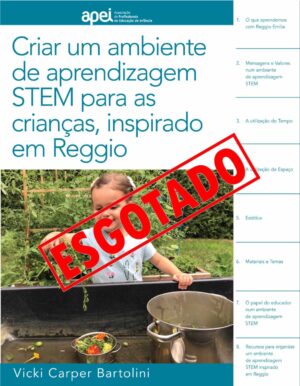
Create a Reggio-inspired STEM learning environment for children (15€)
Vicky Carper Bartolini
Buy €25.00 -

Catrapum, here's another one! (9€)
Rosa Montez
Buy €16.00
Sofia Ambrósio -

Loose Pieces 1 – Inspiring Play in Children (15€)
Lisa Daly & Miriam Beloglovsky
Buy €25.00 -
OCEPE – Curriculum Guidelines for Preschool Education (2016) (11€)
Buy €18.00