
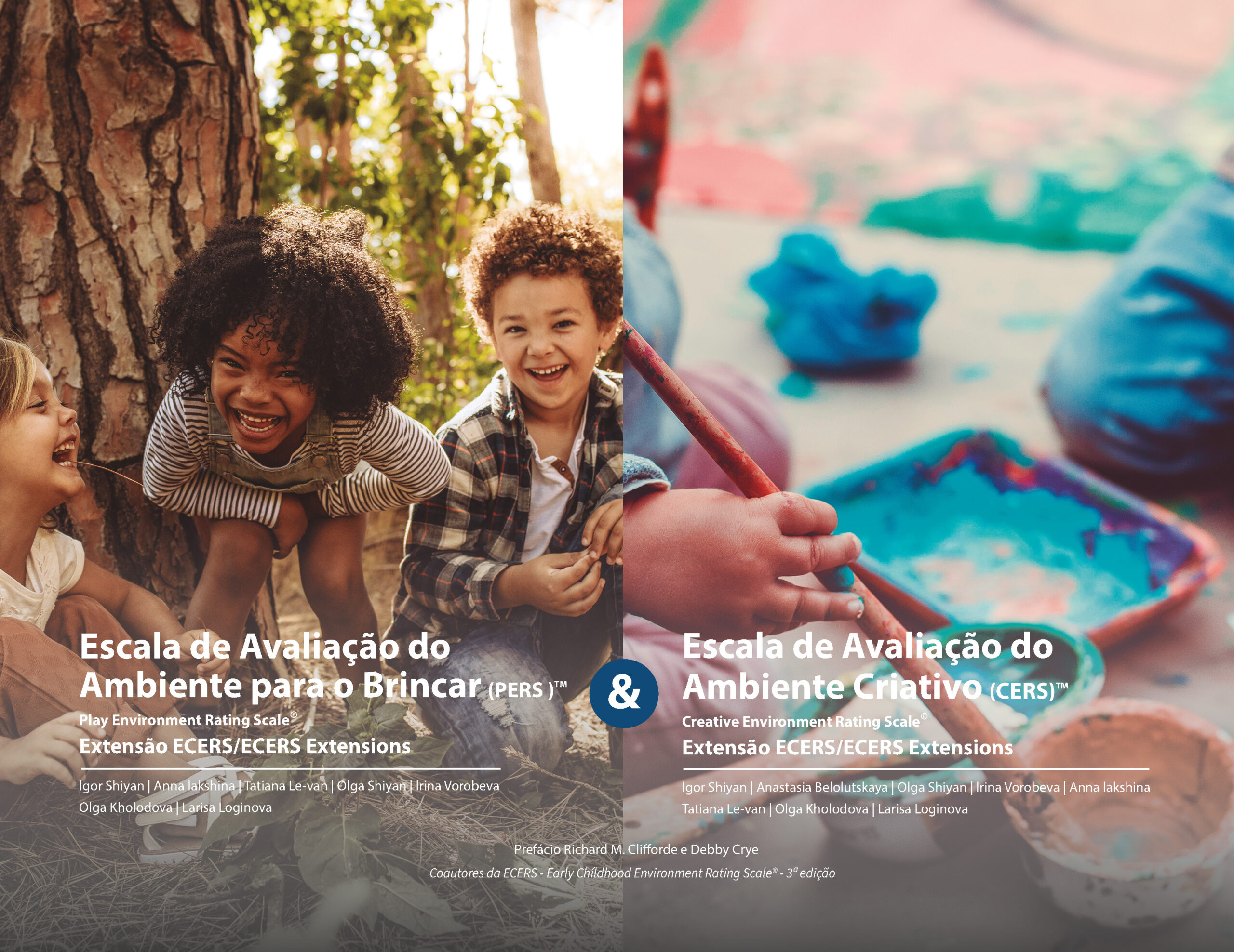
Play Environment Rating Scale (PERS) & Creative Environment Rating Scale (CERS) – Extensions of the ECERS
This instrument is part of the Environment Rating Scale® family of tools, which is internationally recognized as one of the leading sets of science-based tools for improving the quality of early childhood education and learning environments.
The book presents two scales for evaluating the educational environment, designed as extensions of the Early Childhood Environment Rating Scale® – 3rd edition (ECERS-3):
-
the Play Environment Rating Scale (PERS), which focuses on supporting young children's play;
-
and the Creative Environment Rating Scale (CERS), which focuses on the development of creative abilities.
Both scales are based on Lev Vygotsky’s cultural-historical approach and follow the same structure and scoring system as the ECERS®. The PERS and the CERS can be used in preschool and kindergarten settings, allowing for an in-depth analysis of specific dimensions of quality and offering concrete guidance for improving the conditions that support children’s development.
PERS – Play Environment Rating Scale
The PERS is a scientifically based scale designed to analyze and assess the conditions that foster developed (or mature) play, which is essential for children’s imagination and for the development of self-regulation, emotions, communication, social skills, peer cooperation, oral language, storytelling, and literacy.
Structured play also plays a key role in school readiness, self-esteem, motivation to learn, and a successful transition to formal education.
Each item on the scale focuses on a significant aspect of supporting complex play, including:
-
a place to play;
-
the program's structure and free time for play;
-
game materials;
-
adult support for children's play;
-
and peer interaction.
CERS – Creative Environment Rating Scale
CERS is a scientifically based scale designed to analyze and assess the conditions that foster the development of creative thinking and imagination in children, supporting them in generating new ideas, making discoveries, and solving unconventional problems.
Although the importance of creativity is widely recognized in early childhood education, many professionals lack concrete tools to promote it in their daily work. CERS can be used both as a formal assessment tool and as a tool for professional reflection, supporting educators in improving practices that foster creative development.
The scale assesses both environmental conditions and adult-child interactions, focusing on areas such as:
-
an understanding of development processes;
-
encouraging children to ask questions and supporting them in doing so;
-
the invention and transformation of contradictions;
-
and the use of imagination.
About the Authors
Igor Shiyan, PhD, is a researcher and the coordinator of a child development laboratory. He has conducted numerous studies on the assessment and development of creativity in early childhood, based on Vygotsky’s cultural-historical approach. He has coordinated national and international research projects on the quality of Early Childhood Education and Care (ECEC) and has made a decisive contribution to the dissemination of ECERS in post-Soviet countries. He is a co-founder of the master’s program “Assessment and Development of ECEC (Cultural-Historical Approach of Lev Vygotsky).”
Anna Iakshina, PhD, is an educational and developmental psychologist. She conducts research on play and imagination from a cultural-historical perspective and provides continuing education for educators on supporting play in kindergartens. She previously worked as an educator in the Golden Key program, which is based on the Vygotskian approach.
Tatiana Le-van, PhD, is an associate professor and co-creator of the master’s program in Assessment and Development of ECEC (Cultural-Historical Approach of Lev Vygotsky). She is also an active advocate for children’s play, promoting Vygotsky’s ideas through professional development, festivals, and educational competitions.
Olga Shiyan, PhD, researches the development of creative abilities in childhood and adulthood, based on the cultural-historical approach. She is the author of the “Transformations” curriculum for preschool-aged children, which is designed to foster the development of creative thinking and imagination, and has coordinated several studies on quality in early childhood education and care.
Irina Vorobeva, PhD, is an associate professor and co-creator of the master’s program “Assessment and Development of Preschool and School Education (Lev Vygotsky’s Cultural-Historical Approach).” She has published numerous works on assessment and quality development in early childhood education and care, participatory design of public spaces for children, and the professional development of educators; she also works as a parenting consultant.
Anastasia Belolutskaya, PhD, conducts research based on the structural-dialectical approach in psychology, focusing on the mental mechanisms of creative thinking. She actively participates in international research projects on early childhood education, including initiatives by EECERA and the ECERS community.
Olga Kholodova, MEd, has extensive experience in the practice and evaluation of educational environments in early childhood education. She is the author and co-author of more than 20 articles and books on content and quality in early childhood education and care (ECEC), including *Developmental Dialogue in Kindergarten as a Tool for the Development of Cognitive Abilities*.
Larisa Loginova, MEd, has more than 40 years of experience in early childhood education and care as an educator and pedagogical coordinator. She has contributed to several studies on quality assessment and is the author of the handbook *Educational Events in Kindergarten*.
Related
Related Products
-
Pedagogy and Emotional Development in the Education of Children Under Three (20€)
Gloria Quiñones, Liang Li, and Avis Ridgway
Buy €33.00 -

Intervening Early and Taking the Time in the First Years of Life (10€)
Ana Paula Caeiro
Buy €16.50
Isabel Tomázio Correia -

Loose Pieces 4 – Fostering Learning in the 21st Century (€15)
Lisa Daly & Miriam Beloglovsky
Buy €25.00 -
Up Above, the Sky / Down Below, the Mud (18€)
David Sobel
Buy €30.00