
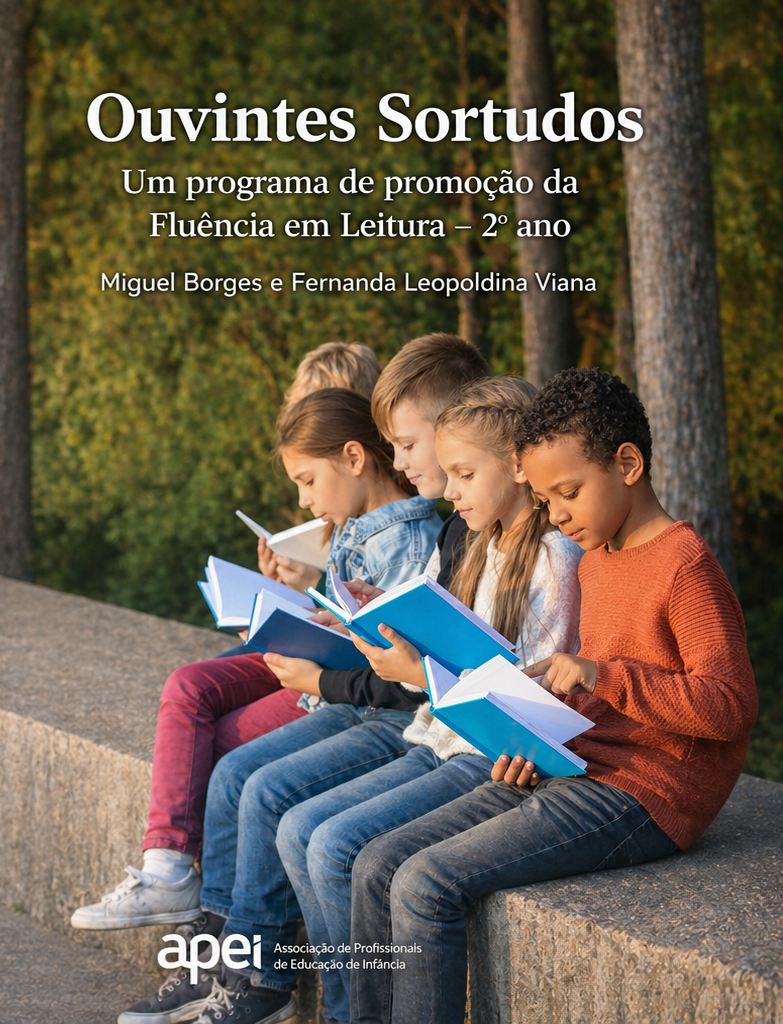
Lucky Listeners – A Program to Promote Reading Fluency (2nd Grade)
“Lucky Listeners” is a scientifically grounded educational intervention program designed to promote reading fluency among second-grade students in the first cycle of basic education. Developed based on research in the field of reading, the program addresses one of the main factors associated with early academic failure: difficulties with fluent reading.
Based on the Simple Reading Model and scientific evidence regarding the relationship between fluency and reading comprehension, the program offers structured and effective strategies—such as reading modeling, guided reading, repeated reading, and dramatic reading—while incorporating a strong motivational and playful component. One of its distinctive features is the involvement of significant adults (parents, family members, or other listeners), who take on the role of “lucky listeners,” reinforcing confidence, motivation, and the joy of reading.
The brochure features:
-
the theoretical framework of the concept of reading fluency;
-
the scientific basis for the proposed strategies;
-
clear guidelines for implementing the program in the classroom;
-
support materials and recording tools;
-
and assessment results that demonstrate the positive impact of the program's implementation on students' reading performance.
Aimed at elementary school teachers, education professionals, and researchers, *Lucky Listeners* is a solid and practical resource designed to support intentional teaching practices that foster more fluent, confident, and competent readers
About the Authors
Fernanda Leopoldina Viana is a psychologist by training, with a master’s degree and a Ph.D. in Educational Psychology from the University of Minho.
She is an Associate Professor at the Institute of Education of the University of Minho, where, in addition to teaching various courses, she has supervised internships for early childhood educators and elementary school teachers.
She has coordinated several research projects in the areas of language development, learning, and the promotion of reading, and has advised numerous master’s and doctoral theses in the fields of Psychology and Educational Sciences.
She was a member of the Gulbenkian Casa da Leitura project team and of the Scientific Council of the PNL.
She was a member of the National Monitoring Committee for the PNEP—National Program for the Teaching of Portuguese—1st Cycle (2006–2010) and served on the Certification Committee for Portuguese Language Textbooks (2009–2010) for the 3rd and 4th grades.
She is the deputy director of the Center for Research in Child Studies and served on the Steering Committee for the Doctoral Program in Child Studies at the Institute of Education of the University of Minho.
She has received four research awards for projects and reading assessments.
He is the author of school textbooks and numerous study guides, and has already published a significant number of children’s books, some of which have been recommended by the National Reading Program.In addition to being deeply knowledgeable about educational dynamics and professional cultures in elementary school, he is a specialist in the field of literacy, having served as a trainer for the PNEP (National Program for the Teaching of Portuguese) and as scientific coordinator of the PIPL (Integrated Program for the Promotion of Literacy).
He is currently the coordinator of the Sparkle project, a literacy initiative funded by Portugal Inovação Social/Parcerias para a Inovação Social.Sparkle is an educational intervention project based on scientific evidence from the field of reading science, focused on developing emerging literacy skills in preschool and early literacy skills in the 1st grade. It promotes the integration of research into teaching practices, supporting educators and teachers in implementing effective and systematic strategies, thereby contributing to improving the quality of learning and to the early prevention of reading difficulties.
Related
Related Products
-
Broken Things Can Be Beautiful (€8)
Marta Cabral
Buy €13.40 -

Understanding Pedagogical Documentation in Early Childhood Education (€15) RECOMMENDED BY PNL 2027
João Formosinho & Jan Peeters
Buy €25.00 -
Up Above, the Sky / Down Below, the Mud (18€)
David Sobel
Buy €30.00 -
Loose Pieces 2 – Inspiring Play in Children from Birth to Age Three (15€)
Lisa Daly & Miriam Beloglovsky
Buy €25.00